


The Platform
Planetary Intelligence. Better decisions, powered by space.
Amelia Space Technologies fuses satellite imagery, ground sensors, and AI into decision-grade knowledge your team can act on.



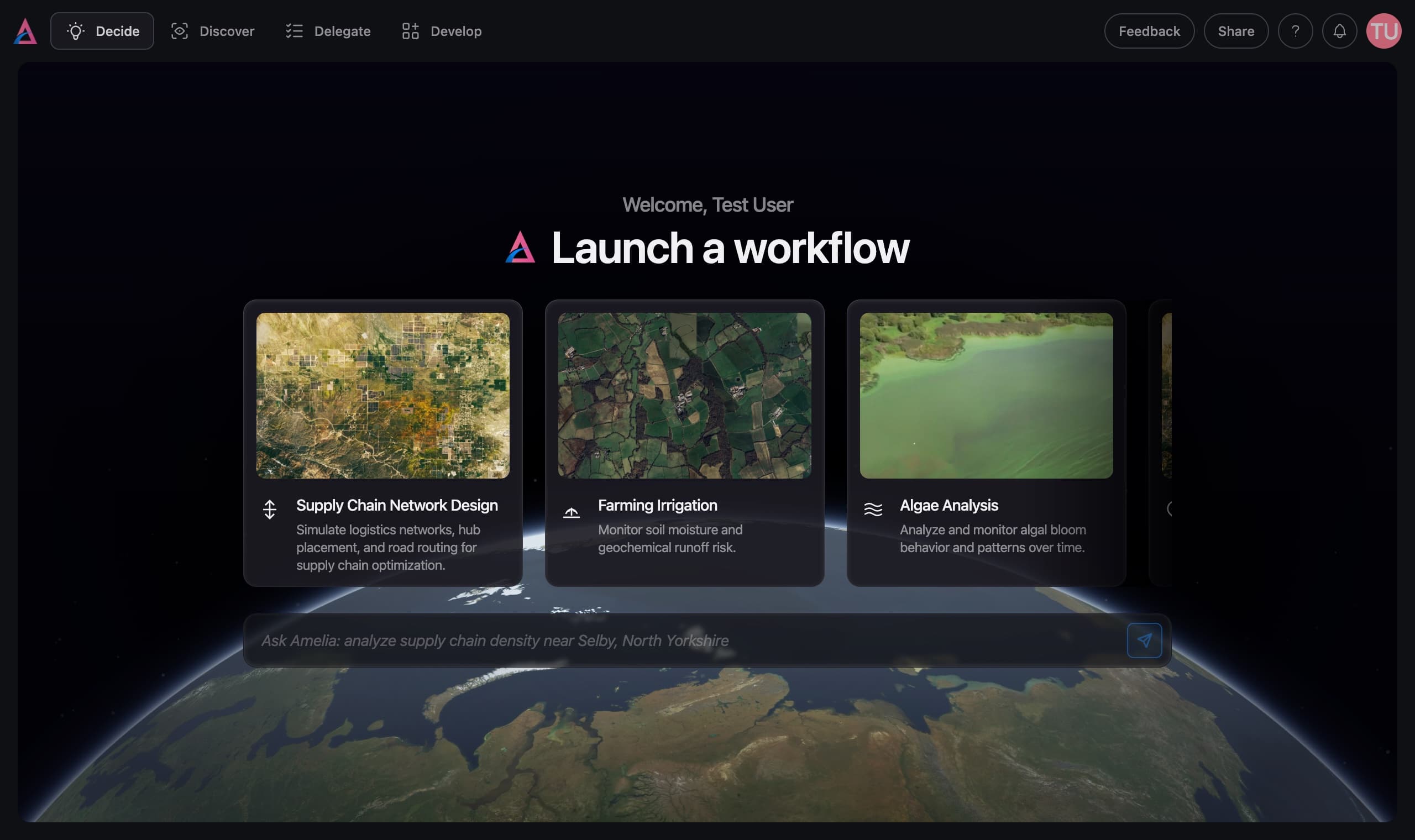
What is the Planetary Intelligence Platform?
The Planetary Intelligence Platform is Amelia Space Technologies’ satellite intelligence service. Ask a question about any place on Earth and it returns a decision-grade answer: what is happening there, how it is changing, and the evidence behind both.
It is built for the people who have to act on that answer. Water utilities and environmental regulators use it to track harmful algal blooms, fuel producers to verify sustainable aviation fuel feedstock, and space programmes to map lunar resources.
What is planetary intelligence?
Planetary intelligence is a composable, queryable model of Earth. Any location, at any moment, can be observed through a stack of capabilities, and the same underlying observation is rendered for the decision in front of you.
One observation, many framings. The operator sees an alert, the regulator sees a record, the analyst sees a time series. The platform is how that intelligence is produced and delivered. The intelligence itself is the product.
Observed, not guessed
Earth's state at a place is composed from several independent sources. No single sensor is asked to carry an answer on its own.
Time is the value
A continuous stream beats a snapshot. A finding that arrives after the decision window has passed is a record, not intelligence.
Provenance travels with the claim
Anything that drives a legal, financial, or safety decision carries its sources and its uncertainty with it.
Active harvest across the majority of fields. Bare soil exposure increasing rapidly. Amelia tracks completion rates across thousands of parcels in near-real-time.
Drag timeline to travel through time
A single satellite image is a snapshot. Stack months of satellite data together and you see a fuller story: what grew, what was harvested, what changed, and what’s coming next. The value is in the combination.
There’s more to see
Satellite data, one of the most underutilised business assets, reveals what is happening across entire regions, continuously, without anyone needing to be there.
Organisations with this access spot opportunities faster, reduce risk earlier, and make better decisions knowing what is actually happening on the ground.
Built to give you a competitive edge
Unlock the intelligence hidden between layers of data
Save Money
Intuitive ask and search engine for analysis in minutes, not months.
Reduce Complexity
Easier collaboration to reduce project management overhead.
Protect Assets
Autonomous monitoring and alerts that save time and reduce risk.
Increase Access
AI systems and proprietary algorithms for deeper sector insights.
Gain Outcomes
Go beyond digital analysis and gain real-world results.
Planetary scale systems thinking
Amelia starts every project by understanding the environmental system that drives the outcome, before layering on satellite data and AI.
On Earth, that system looks like this:
Stage 1
External Drivers
Weather & climate
The conditions that set the stage: temperature, wind, rainfall, radiation.
Stage 2
Source
Human activity
Land use and human activity that introduce material into the system.
Stage 3
Transport
How it moves
Rivers, currents, air or infrastructure carrying that material onward.
Stage 4
Receiving System
Where it accumulates
A lake, a reservoir, a coastline, an airspace: where conditions compound.
Stage 5
Outcomes
What matters
The signals that are actually operational: what you would act on.
Whether it's algal blooms, maritime emissions, or lunar exploration, systems thinking is the difference between reacting to a problem and seeing it coming.
For your organisation
Reinforced workflows and capabilities
Each workflow chains multiple capabilities together, each output feeds the next. The result is something no single model could reach alone.
Sustainable Aviation Fuel
Where should we build our storage hubs and pre-treatment facilities?
Score candidate sites against feedstock proximity, road access, grid connection, and planning constraints to identify optimal locations for your hub network.
Example query
“Show me RSB-eligible feedstock sourcing areas within 50km of our facilities”
Capabilities are like ingredients, workflows are like recipes. Together they create a complete dish.
Supply Chain Network Design
Evaluate hub placements, routing, and costs across multiple scenarios
Feedstock Sourcing
Map biomass availability, estimate yields, and rank collection zones
Regulatory Compliance
Cross-reference sites against ISCC, RSB, and EPA RFS frameworks
One platform. Four ways to work
Analysis in minutes, not months. What used to require a GIS team is now accessible to everyone.
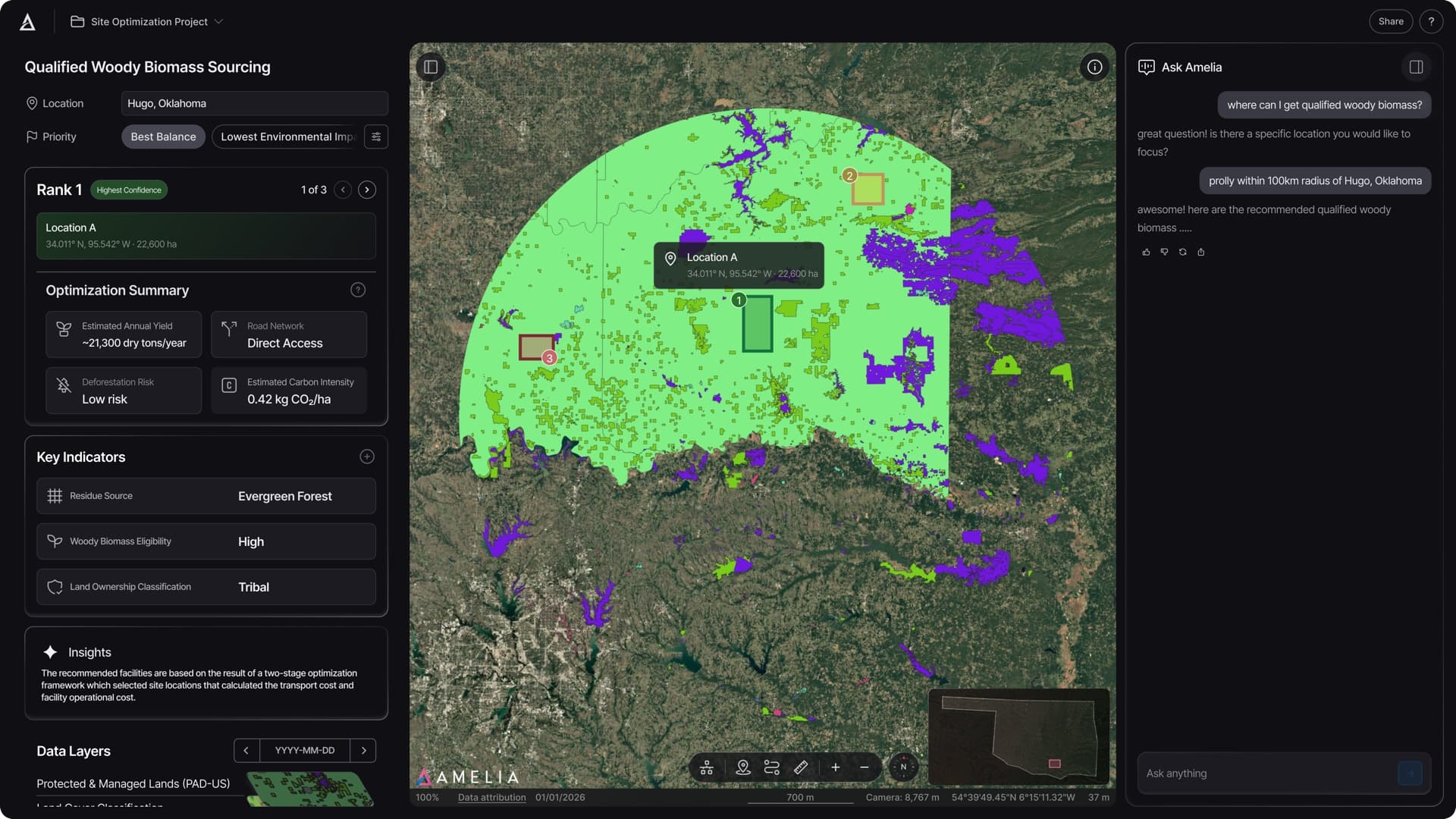
Decide
Ask better questions, get better decisions.
Ask a question in plain language. Amelia orchestrates the analysis — selecting satellites, running models, cross-referencing data — and delivers findings you can act on.
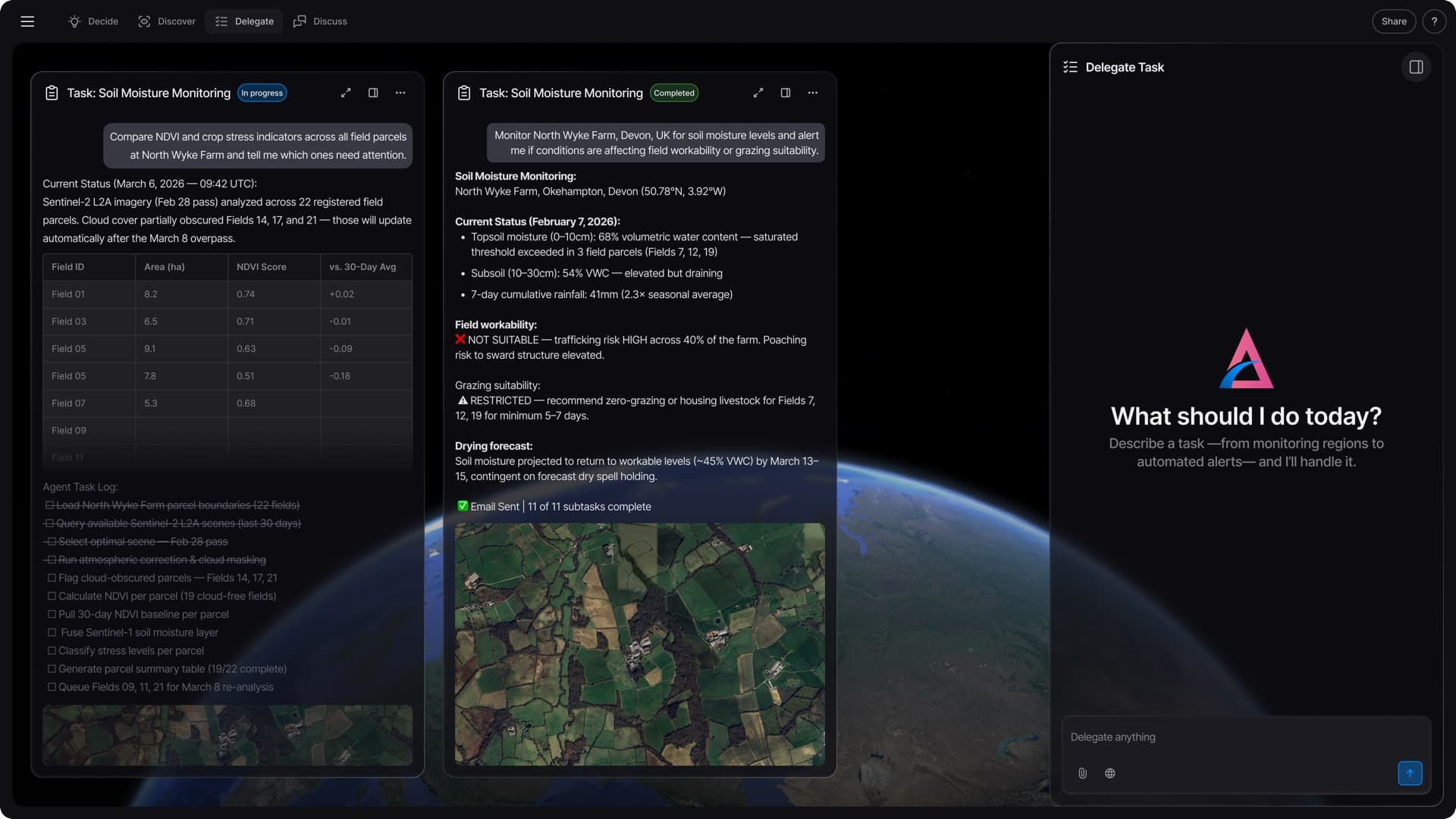
Delegate
Let Amelia work while you sleep.
Tell Amelia what to watch. It monitors continuously and alerts you when conditions change. A 24/7 intelligence system that never misses a signal.
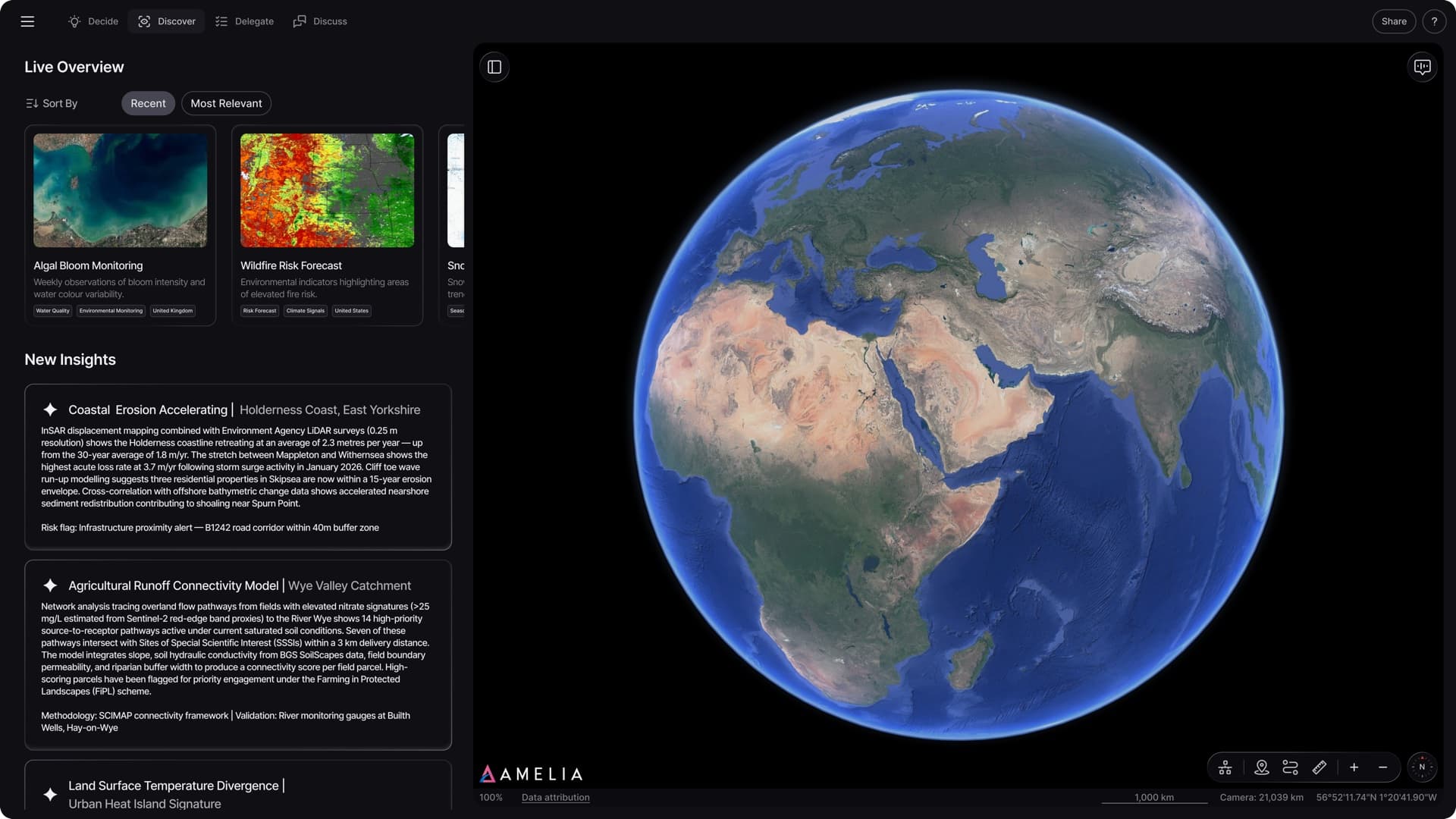
Discover
See what you didn’t know to look for.
Amelia analyses the world autonomously — surfacing patterns, anomalies, and opportunities invisible to conventional analysis. Before you think to ask.
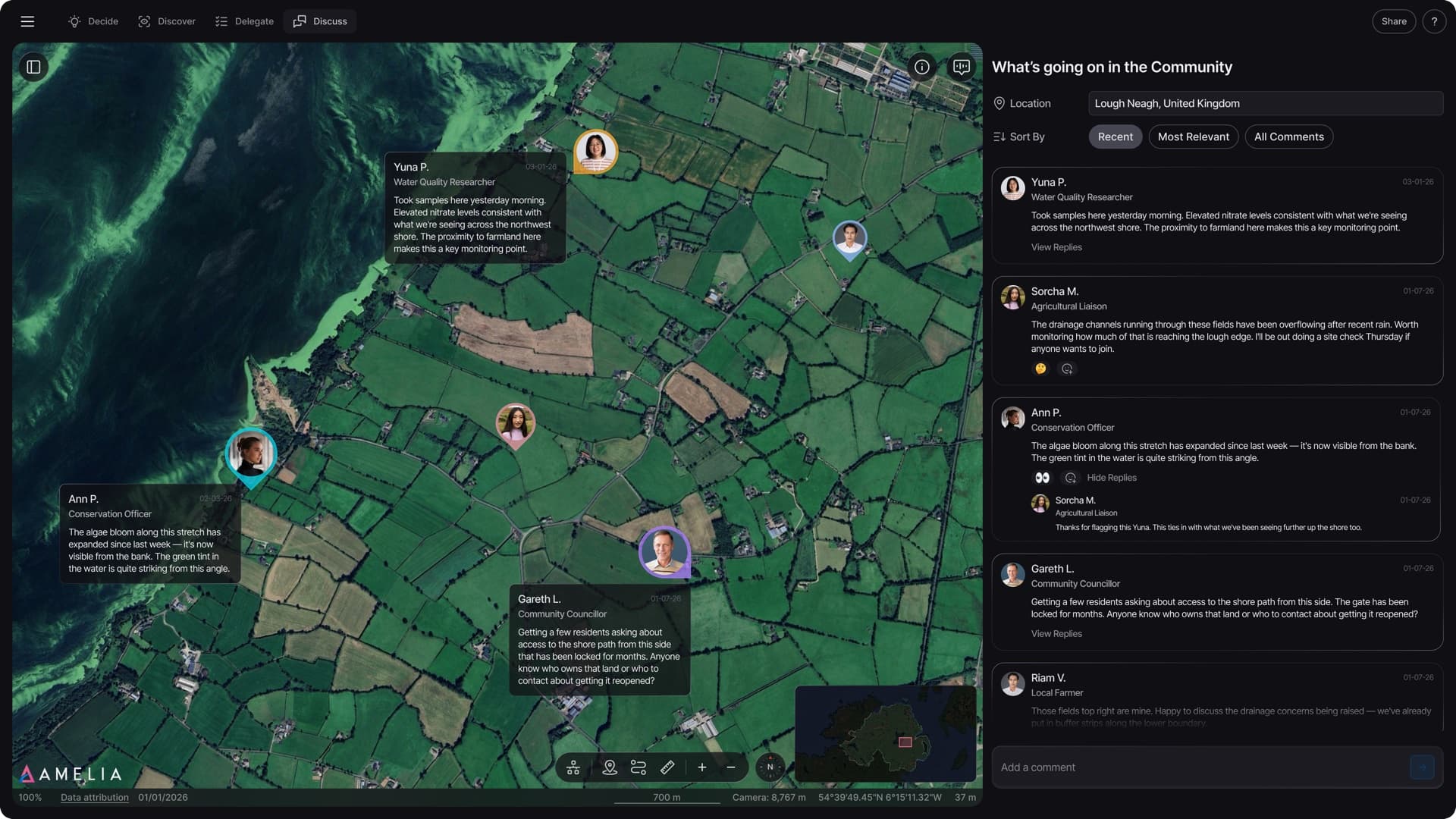
Discuss
EmergingBetter insights with multidisciplinary collaboration.
Researchers, domain experts, and developers contribute capabilities to the platform. A satellite scientist’s analysis alongside a farmer’s field observations alongside a policy analyst’s regulatory context.
Common questions
The platform, answered plainly.
What is the Planetary Intelligence Platform?
What satellite data does Amelia use?
Who is the platform for?
How is this different from buying satellite imagery or a GIS dashboard?
Can satellite monitoring replace ground sampling?
Get early access
Drop your email and we'll let you know when your access is ready.